

Beijing Has Already Decoded Trump's Visit
How China's institutional elite is reading the moment, and why Washington cannot see what they see

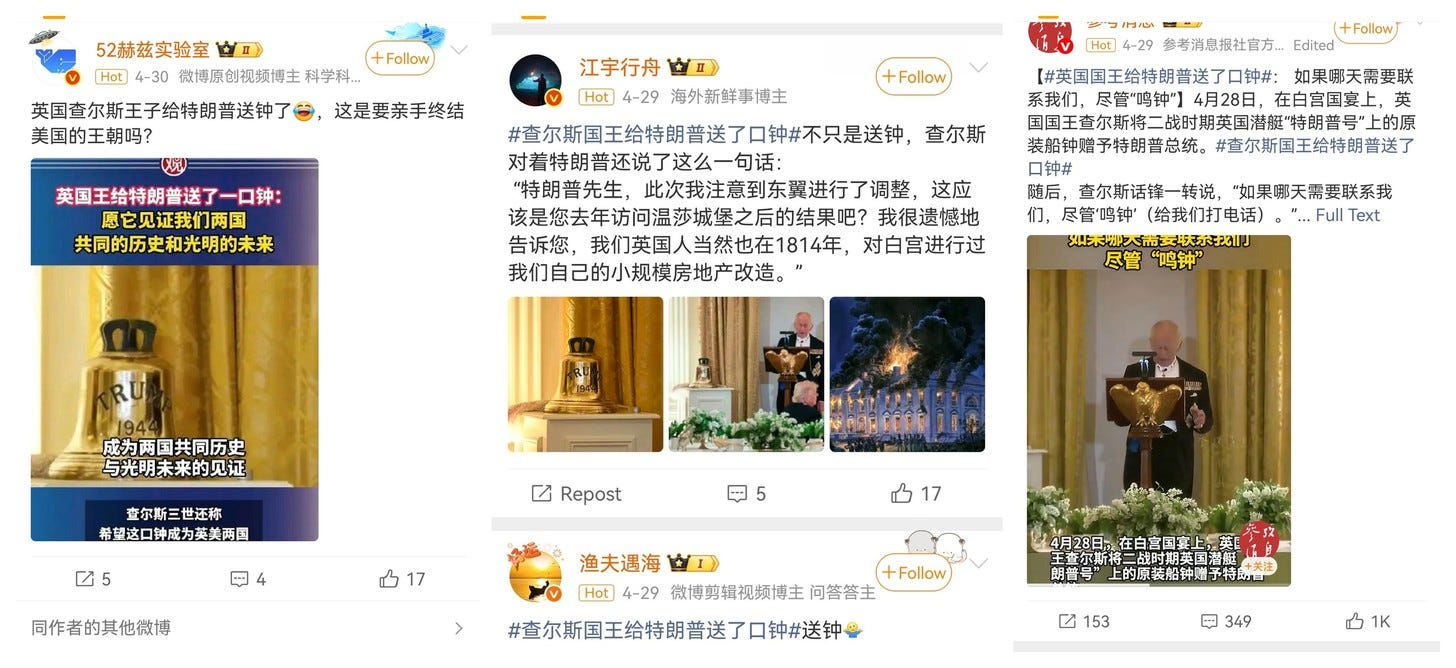
To see what Beijing is seeing in the photograph of King Charles handing Donald Trump a bell, one must be fluent not in Chinese but in Chinese. The English-speaking world saw a chime, an heirloom, a quaint piece of soft-power theater. The Chinese-speaking world saw 送钟. The phrase is a near-perfect homophone for 送终 — to attend a death, to perform the rites at the bedside of the dying, to close the eyes of the man whose funeral one has come to oversee. Within hours the photograph was on Weibo with captions written by people who had not consulted a dictionary because they did not need to. They had not learned the homophone. They had been raised in it. By the time American newsrooms were running B-roll of the ceremony, the Chinese internet had already buried Trump.
The bell, by itself, is not the story. Homophone gifts have been mistranslated across the Sino-Western seam for as long as there has been a seam. Clocks at weddings, pears split between friends, the number four engraved on hotel elevator panels — the catalog of small mutual incomprehensions is long and largely tedious. A diplomat with a competent protocol officer would have caught the bell. The interesting question is not what was missed in London. It is what becomes visible once one stops staring at the missed thing and looks at what surrounds it.
What the bell allows you to notice is that there is a lens. China's institutional elite, meaning the brokerage analysts and the policy researchers and the WeChat commentariat that the cadre actually reads and the editors at the Party-adjacent journals, has been assembling a way of seeing the Trump visit for at least three months. The lens is not hidden. It is published, republished, propagated, and rehearsed across every platform that matters in the Chinese-language information environment. It has historical analogies, institutional sponsors, capital-allocation implications, and a settled vocabulary. By the time Trump's plane lands at Beijing Capital on May 14, the lens will have been calibrated and circulated to every Chinese institutional actor whose interpretation of the visit will matter. None of this has appeared in the English-language coverage of the visit. The remainder of this essay is about the lens. What it is made of, how it was built, and what someone looking through it sees.
On April 17, 2026, China's largest investment bank published the twenty-first issue of its semi-monthly geopolitical research series. The thirteen-page report carried the title 从"苏伊士时刻"到"霍尔木兹时刻". From the Suez Moment to the Hormuz Moment. Its argument is that the United States in 2026 is in the position Britain occupied in 1956. Britain went to Suez to retake the canal, lost the canal, and lost the empire. The United States has gone to Hormuz to keep the strait open, has not kept it open, and is in the process of losing something larger than the strait. The report names the larger thing as global hegemony. The Western press that picked up the report, principally the South China Morning Post on April 20, treated it as commentary. Provocative commentary, perhaps. Worth a column, certainly. Commentary all the same. It is not commentary.
A research note from CITIC Securities is not what a Western reader assumes a research note is. CITIC Securities is the largest investment bank in China by every metric that matters. Its controlling shareholder is CITIC Group, which is wholly owned by the Ministry of Finance of the People's Republic of China. The chain of ownership runs from the Ministry of Finance through CITIC Group to CITIC Limited to CITIC Securities, and the chain of authority runs in the opposite direction. The chairman of CITIC Securities, Zhang Youjun, has been at the firm since its founding in 1995 and serves concurrently as Party Committee Secretary, which in a Chinese state-affiliated enterprise is the senior of the two roles. He did not write the April 17 report. He authorized it. The research division he oversees is the largest sell-side research operation in China by analyst headcount, and its thematic notes do not appear by accident. They appear because someone at the top of the firm has decided, in coordination with the broader policy ecosystem in which the firm sits, that a particular analytical frame is ready to be installed in the institutional consensus. CITIC Securities is not Goldman Sachs. It is closer to what Goldman Sachs would be if Goldman were owned by Treasury and chaired by someone whose career advancement was managed by the personnel office of the ruling party. The April 17 report was not a thought. It was an instrument.
Within seventy-two hours, the frame had spread. The South China Morning Post carried it in English on April 20. Sina Finance and Guancha republished in Chinese the same week. China.com Military picked it up. NetEase ran the analysis. By April 30, the analytical channel of China Youth Daily had extended the frame in a long essay that called the Suez moment 英国霸权的葬礼, the funeral of British hegemony, and described the Hormuz moment as 押着同样的历史韵脚, rhyming the same historical line. The phrase is a deliberate echo of Mark Twain. Chinese commentary is now quoting Mark Twain at America in Mandarin. The propagation is not viral. Viral propagation is what happens when a frame catches because it is striking. This propagation is institutional. Each republication is a node in a coordinated analytical posture, and the speed of the spread is the signal that the nodes were waiting for the frame to be issued. By the time the visit happens, every Chinese institutional reader who matters will have absorbed the lens at least three times, in three slightly different registers, from three sources whose authority overlaps just enough to install the consensus and not enough to make the installation feel coordinated.
The most analytically interesting feature of the report is what it does not say. The thirteen pages contain Suez. They contain Vietnam. They contain Hormuz. They contain four operational inferences about American strategic retrenchment, the loosening of Gulf alliances, China's posture in the multipolar wave, and the bilateral recalibrations that follow. They do not contain Trump's visit to Beijing on May 14. The visit is not mentioned by date. It is not mentioned by allusion. It does not appear in the four inferences, which is the natural place it would have appeared if the authors had wanted it there. The omission is not oversight. A research team writing on April 17 about the trajectory of American hegemony, with the President of the United States arriving in Beijing twenty-seven days later for a state visit conducted under the shadow of the war the report is analyzing, did not forget to mention the visit. They chose to hold it outside the frame. The choice is the frame's most important feature. By refusing to tie the analysis to a specific event, the report installs an analytical posture that the visit cannot disturb. The visit will happen inside the lens, not outside it. Whatever the joint statement says, whatever Trump claims to have extracted, whatever the readout reports, the institutional reader who has absorbed the April 17 frame will receive the visit as one more data point inside an analysis that was settled before the President boarded Air Force One.
Once you see the lens, the bell is no longer a curiosity. It is a confirmation. The White House ceremony took place on April 28, eleven days after CITIC published the report. The Chinese internet did not need to read the report to read the bell. The frame was already in the cultural water. The institutional analysts had named the trajectory in the register of brokerage research. The Weibo commentariat read the same trajectory in the register of homophone meme. The two registers do not communicate with each other directly. They do not need to. They are reading the same underlying fact through different organs of the same body. Charles handed Trump a bell. The bell rang in two octaves at once. One was audible to anyone with a state protocol manual. The other was audible only to those raised in the language. Both rang the same note.
While Beijing was assembling its lens, Washington was preparing for a negotiation. The American press has been covering the visit in the register of trade. What concessions Trump will extract on tariffs. What he will offer on Taiwan. What posture he will strike on rare earths. What the joint statement will say about technology export controls. None of this coverage is wrong. The visit will produce a joint statement. The statement will contain trade items. Both sides will claim wins. The financial press will run the wins through their models, the political press will run them through their narratives, and the Beijing-correspondent class will file dispatches assessing who won the room. The dispatches will be filed in good faith and will be largely accurate as descriptions of what was said. They will also miss the visit entirely. The visit is not a negotiation. The visit is the empirical event that the lens has been assembled to interpret. Beijing is not going into the room to bargain. Beijing is going into the room to observe. What the institutional consensus will absorb from the observation, and how the consensus will calibrate Chinese policy in the months that follow, is the deliverable. None of it will be reported, because it is not the kind of thing that gets reported. It is the kind of thing that gets priced.
The lens is not invisible to everyone in the West. It is invisible to people who report on China for a living. Other people, working in other registers, have already sense what the lens sees. Jimmy Kimmel went on national television and said Melania had the glow of an expectant widow. The line landed because the studio audience felt what Beijing had already named. The CITIC analysts wrote, in language polished for institutional consumption, that 盎格鲁-撒克逊国家撇清关系,北约成员国集体拒绝,海湾盟友纷纷中立,亚太盟伴小心躲闪 — Anglo-Saxon countries distanced themselves, NATO members collectively refused, Gulf allies stayed neutral, Asia-Pacific partners dodged carefully. This is the alliance defection cataloged with the precision of someone watching from outside. American foreign-policy commentators do not write that sentence. They cannot write it. They are inside the alliance, and the alliance does not look from inside the way it looks from Beijing or from a late-night studio in Burbank. The bell, the report, and the comedian's line are the same diagnosis in three registers. None of them are talking to each other. All of them are looking at the same patient.
None of this is hidden. The CITIC report is on the firm's institutional research distribution. The bell footage played on every news network with a London bureau. Kimmel's monologue ran on ABC. The Weibo captions have repost counts in the tens of thousands. The China Youth Daily essay is a Google search away. There is no secret being kept and no document being suppressed. The only thing standing between an English-language reader and the lens is the requirement that the pieces be assembled, and that the assembly be done by someone reading from inside two language ecosystems at once. A Western analyst who reads only English cannot see the lens because the lens lives in Chinese. A Chinese analyst who reads only Chinese cannot see the corroboration because the corroboration is happening in American late-night television and in the body language of European foreign ministers. The seam is not a barrier. It is a vantage. Almost no one occupies it. Anyone who does can describe what the people on either side cannot.
Trump arrives in Beijing on May 14 to negotiate a trade deal. Beijing is not negotiating. Beijing is taking the readings on a man whose own country has already begun the rites. The joint statement will be drafted, signed, photographed, and dispatched to wire services in two languages. The wire services will report it accurately. The institutional readers in Beijing who have spent four weeks looking through the lens will receive the statement, file it, and continue calibrating against the analysis that was settled before the President left Washington. What the lens shows them is not a negotiation between two powers of comparable standing. It is a measurement, taken at close range, of how much further the descent has progressed. The measurement will inform the next two years of Chinese policy. The joint statement will inform a news cycle.
The wake was announced on April 18. The body arrives May 14.
Correction (May 13, 2026): An earlier version of this piece referred to the bell ceremony as having taken place at Buckingham Palace. It took place at the White House state dinner on April 28. Corrected with thanks to a reader.
Sources:
CITIC Securities Research. “从’苏伊士时刻’到’霍尔木兹时刻’” [From the “Suez Moment” to the “Hormuz Moment”]. Geopolitics Semi-Monthly, Issue 21, April 17, 2026. Available through CITIC Securities institutional research distribution.
South China Morning Post. “’Hormuz moment’ could herald decline of US dominance: Citic Securities analysts.” April 20, 2026.
China Youth Daily. “解局|从’苏伊士时刻’到’霍尔木兹时刻’” [Breaking Down the Situation | From the “Suez Moment” to the “Hormuz Moment”]. April 30, 2026.
Now that was worth a read, good analysis.
The bell as 送钟 was already all over my Chinese social media before I saw a single English-language report about the ceremony — I just didn’t know why it landed so hard until reading this. The Kimmel line, the CITIC report, and the Weibo captions all saying the same thing in three different registers, none of them talking to each other is such a good point. “The wake was announced on April 18. The body arrives May 14.” Subscribed.